
 Posted by
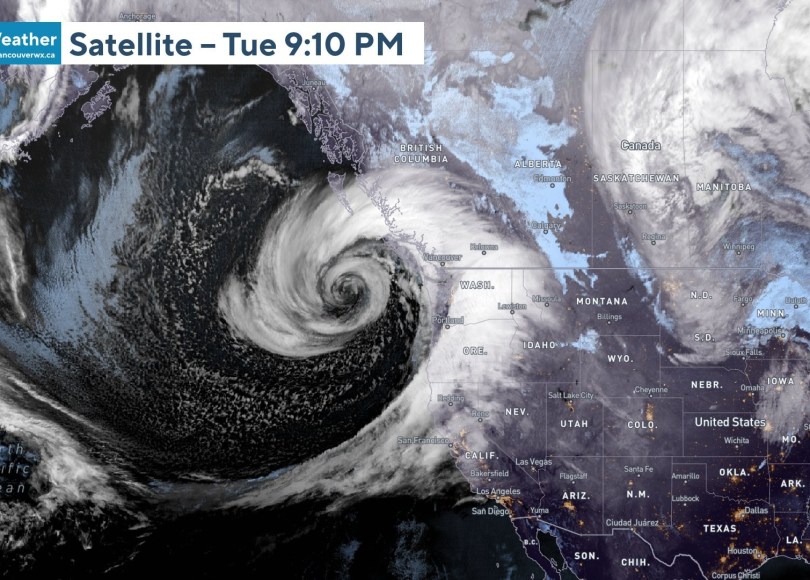
 Last Tuesday, a frontal cyclone rapidly deepened over the Pacific Ocean about 1,000 km to the west of Seattle. The storm was a “triple bomb”, meaning it reached around triple the 24 hPa in 24 hours threshold for explosive cyclogenesis, or “bombogenesis”. The minimum pressure reached about 945 hPa by Tuesday evening, one of the lowest pressure readings ever recorded in that part of the Pacific Ocean. We’ll never know the exact minimum because the storm took out the closest buoy, designated buoy 46005, prior to reaching peak intensity.
The storm produced some incredible eye candy and was the leading story on the national news on Wednesday.
Given there was a record-breaking storm in proximity to the PNW, one might naturally expect that the storm would produce major damage. Many Seattle residents fielded texts and phone calls from friends and family in other parts of the country asking about how we were faring during the big storm.
There was pretty much just one impact from this storm — extreme localized wind. By midnight Wednesday, more than half a million customers in western Washington had no power, including almost the entire eastern suburbs of King and Snohomish counties.
To many people casually following the storm, the 1:1 relationship between the bomb cyclone and extreme wind seems pretty straightforward. Big storm produced big wind. End of story.
To those who follow PNW weather more closely, the distribution of wind damage looked atypical. The wind direction was different than usual events, the strongest winds were less widespread, and the winds were not particularly strong in areas prone to “gap” winds such as North Bend. Many reports suggested that some of the worst damage was in a band from Maple Valley-Hobart up through Redmond, an area not known for being the epicenter of strong windstorms. So I thought it was worth ending my blogging hiatus to give a little more meteorological context to what happened here.
This event was a textbook example of a downslope windstorm — a phenomenon that is more commonly observed in places like Boulder, Colorado, but can occasionally happen in western Washington when conditions are right.
What is a downslope windstorm?
In short, downslope windstorms occur when flow going over a mountain rapidly accelerates as it descends on the lee side of the mountain before undergoing a hydraulic jump, resulting in highly turbulent flow close to the ground on the downstream side of the mountain (near Boulder in this case).

The theory of how downslope windstorms form is a bit tricky to describe because the math uses highly idealized terrain and fluids. The closest analogy to what occurs in the atmosphere is when shallow water in a river flows up and over a smooth rock before undergoing a rapid and turbulent “hydraulic jump” downstream of the rock that appears visually incongruent with the surrounding slower streamflow.
The equations require the air above the mountain to be close to a “critical level” that is determined by the height of the mountain and the speed of the wind. Under certain goldilocks conditions, the wind can accelerate on both the upwind and downwind side of the mountain before undergoing the abrupt hydraulic jump near the base of the mountain on the lee side that is akin to the river water flowing down over the smooth rock.
Practically, meteorologists know to look for a number of conditions that can potentially lead to downslope windstorms (Markowski and Richardson 2010):
- Strong cross-mountain winds (> 30 mph) at and just above mountain-top level associated with surface high pressure upstream and low pressure downstream.
- A stable layer near or just above mountaintop, and a layer of lesser stability above.
- A level that exhibits a wind direction reversal, or where the cross-barrier flow simply goes to zero (this indicates a critical level).
- Absence of a deep, cold, stable layer in the lee of the mountains, which may keep the downslope flow from penetrating to the surface.
For (1), the low-level flow was orientated from east to west and the bomb cyclone provided the pressure gradient and winds across the Cascades. Note the direction of the 10m wind barbs across the Cascades in Washington State below, from 7 PM Tuesday.

For (2) and (3), frontal boundary was responsible for providing both the stable layer and the wind reversal above the height of the mountains. This may have been the most important aspect of this event — the center of the bomb cyclone remained well offshore but it had an amazing occluded front that curved from British Columbia down through Washington, Oregon, and northern California. A satellite image from 9 PM Tuesday shows the front directly over the Cascades:

Higher up in the atmosphere, at 500 hPa, the wind was blowing from the southwest.

In order for the wind to veer from easterly at low levels to southwesterly at upper levels, there must have been a critical level in the middle where it was exactly from the south, meaning the cross-barrier flow across a north-south orientated mountain range like the Cascades would be exactly zero. This is an essential condition for a downslope windstorm to be possible.
The stable layer within the frontal boundary was a little harder to pick up, but the UW-WRF forecast sounding for 10 PM Tuesday night does show detect the front around 800 hPa, along with the wind shift and a layer of slightly greater stability (less temperature decrease with height). The wind speeds were also in excess of 50 kt both above and below the front.

Condition (4) is also clearly satisfied in the above sounding — there was no stable layer near the surface, as would be expected in the evening of an active weather day where the surface was well-mixed.
Did the weather models capture the windstorm?
Most models did show strong wind gusts in western Washington on Tuesday evening. However, the global models appeared to show more of a gap wind event, with the strongest winds downstream of the mountain passes in areas like North Bend. The only model that appeared to correctly detect mountain wave activity was the UW-WRF, and in particular the high resolution 1.33 km version run that resolved the fine-scale details of the terrain well enough to pick up on the mountain wave activity.
The 1.33 km maximum wind gust forecast for 10 PM Tuesday from the Tuesday morning WRF run shows gusts of up to 60 kt (70 mph) in the eastern suburbs of Seattle. The highest blue and orange contours are almost exactly in the location where the strongest winds were observed, from Enumclaw to Issaquah to Redmond. These locations are also tend to be directly to the west-northwest of taller mountains, which is exactly where one would expect a hydraulic jump.

The UW-WRF also has another nifty product that shows the maximum wind speed within 250 m of the surface. Ripples that look like gravity wave signatures are even more apparent just above the ground in a number of locations such as south of Tacoma. The tricky part about mountain wave forecasting is that some of these mountain waves were likely just above the ground but high enough to avoid catastrophic damage. Airplanes approaching Sea-Tac certainly felt these waves, as a number of flights had to abort landings or divert to other airports.

The UW-WRF also outputs a west-east cross section which starts at the Pacific coast on the left side and runs through Seattle and Leavenworth before ending on the right near Spokane. Here are two of those cross sections showing the wind speeds in color contours. These are forecasts for 7 PM and 10 PM last Tuesday:


Both of these cross sections readily show a band of strong wind accelerating down the western slopes of the Cascades along with a series of waves reaching close to the ground on the eastern side of the Puget Sound lowlands.
So the evidence clearly points to a downslope windstorm being the culprit of the strongest winds, with the 1.33 km UW-WRF almost perfectly nailing the location of the worst damage.
It wasn’t just the model that nailed the forecast — meteorologists at NWS Seattle also picked up on the mountain wave threat on Monday morning and issued high wind watches and warnings for the correct locations.
This flow reversal brings up the possibility of mountain wave activity in the foothills Tuesday night in addition to the strong easterly winds caused by the gradients. Always hard to predict where the mountain waves will surface if they develop. In past mountain wave events Enumclaw, Buckley, Black Diamond and as far west as Maple Valley have been hit by surfacing mountain waves. Will issue a high wind watch for Tuesday night for the coast, Western Strait of Juan de Fuca, East Puget Sound Lowlands and the Bellevue area.
What were the strongest observed wind gusts?
Unfortunately, the combination of a lack of quality 10 meter anemometers and widespread power outages meant there were few observations of the strongest winds in the locations that the worst damage occurred.
The Enumclaw RAWS station reported 66 mph and storm chasers in that general area also measured 70+ mph winds. I can’t find any observations of strong winds around Issaquah, but the tree and roof damage around Issaquah high school and Mirrormont suggests 60-70 mph winds as well. The unusual wind direction was also likely a culprit in knocking down trees.
Wrapping up
The popular narrative that a record-breaking bomb cyclone produced strong winds in the Seattle area is basically correct, but this post hopefully provided some added context to those wondering why the strongest winds occurred in some unusual locations.
As someone who specialized in mountain meteorology in graduate school, I find these windstorms fascinating and I hope some of that was reflected in the analysis above. If any of my readers have further context to provide from observations on the ground, I’d love to hear about it in the comments section below.
 The Convergence Zone
Just a word of thanks for the great explanation of this recent weather event!! I understand now why we experienced comparatively moderate winds and damage on BI and was absolutely stunned the following day to learn of the severe damage in Bellevue, Bridal Trails, and eastern foothills. I still receive calls from family and friends about the storm and now I can explain (broadly…) what happened.
Glad you’re back!
Best,
Gary
>
LikeLike
Great post Joe! The UW WRF and NWS both nailed this forecast. Can you think of any similar downslope windstorms to this one in the region’s history? Oct 24, 2021 (the “other” bomb cyclone) comes to mind, but it had significantly weaker gradients and I don’t recall if it had the same sort of downslope signature that this most recent cyclone had.
LikeLike
That’s a good question Charlie, I seem to recall gap winds in the 10/24/2021 storm, but it was quite similar. Almost every occluded front likely generates mountain waves aloft but usually they don’t reach the ground…would have to re-run WRF for that case and check it out.
I think there were some mountain wave events in the 2000s but that was before my time living in this region.
LikeLike
This was a great analysis, Joe. Thanks for going so in-depth to help explain the storm. The mountain wave activity certainly makes sense given the damage I found between Maple Valley and Issaquah.
LikeLike
Excellent report. I recently moved to Issaquah, settling at the base of Tiger Mountain in an area called Mirrormont—yes, that’s the correct spelling. You asked if there was anything to add to your story, and I think it’s worth mentioning the significant rainfall in the weeks leading up to the storm. The ground in our area was already saturated, which likely contributed to the extent of the damage.
As an avid follower of weather events worldwide, I ventured out the morning after the storm to gather supplies. The destruction I witnessed was unlike anything I’ve seen before. I captured some short videos and a few photos, but what truly stood out were the uprooted trees. The massive root balls of some trees towered as high as 25 feet into the air. The flattened roots jutted out at a 90-degree angle to the trunks, creating a surreal sight.
Some trees were snapped and twisted as if a giant had angrily torn them apart. I vividly recall the clean, unblemished wood of a few 30-inch-diameter fir trees, their trunks shattered. The sheer force and instantaneous power it would take to cause such devastation is mind-boggling.
I’d like to express my gratitude to the writer of this story and an even bigger thank-you to the men and women who have worked tirelessly to repair the damaged roads. Their work is extremely dangerous, especially with downed power lines scattered across the streets.
Anthony L Kay
Partially written by Chat GPT
LikeLike
Hi Joe! Great article. Someone messaged my page saying he measured a 87 mph gust right in old town, 3 stories up near the roof line. The same person mentioned that a science teacher at Issaquah Highschool measured a 90mph gust in town. I’m trying to find more information on the brand of the weather station and how exactly they were install.
LikeLike
Thanks Ben if you can get ahold of that weather data I would be really interested. Cliff would be interested in it also.
LikeLike
Hey Ben any chance you could fill out the contact form so I can follow up via email? Thanks
LikeLike
Sure thing.
LikeLike
Thank you Joe for the detailed explanation this lay person can understand. We’ve lived on the northeastern side of Squak Mountain for over 30 years and are usually somewhat shielded from the typical southwestern winds, so this storm was surprising for us.
LikeLike