
 Posted by
 by Ana Ordoñez
For hydrologists and meteorologists in the northern hemisphere, October 1 is the start of the 2021 water year. It is a great time to reset the calendar from a weather perspective – here in the northwest the soil is dry, snowpack is low, and it is starting to rain again. In more technical terms, October 1 is when the season of maximum evapotranspiration is over and soil moisture recharge begins. So, how did things go in water year 2020?

Early on, Seattle (pictured below) and Portland had an unusual dry spell with no rain during the first week of November. It ended up being a particularly dry month for Seattle, with only 1.7 inches overall (which is more typical of May or June here). Despite this, we soon saw some notable rain. Seattle had its wettest day in the decade (and 5th wettest day ever recorded) on December 20, 2019 when 3.25 inches fell during a significant atmospheric river. In January, Seattle then tied the record for most rainy days during the month.

This trend did not let up in early February, when a couple of atmospheric rivers caused substantial flooding and landslides in many parts of Oregon and Washington. The Umatilla River in eastern Oregon and Mill River in southeast Washington experienced historically high flows.
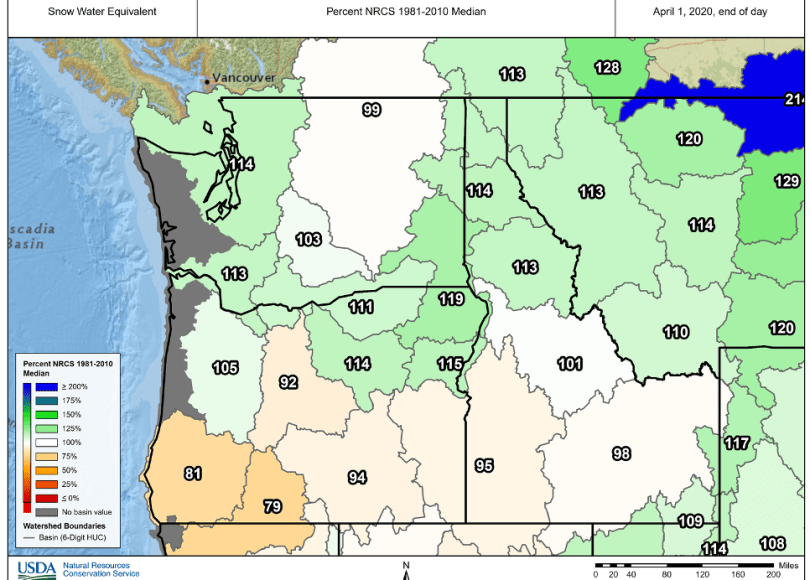
This stormy winter also contributed to snowpack building in the Cascades. Snow amounts in the Cascades got off to a slow start in December and January, but through a series of winter storms we finished the winter with more typical amounts. By early April, most basins in Washington, Oregon, and Idaho were seeing near-to-above normal SWE (snow water equivalent) amounts.

There were some sub-basins with closer to 70%-80% of average SWE amounts on the east side of the Cascades and in central Idaho, while parts of the western Cascades, Blue Mountains, and Idaho panhandle saw over 120% of their typical SWE amount.
With spring, big rain events unfolded to the east. Spokane, Pullman, and Lewiston all broke daily rain records on May 20, 2020.
In Boise, June was one of the top three wettest Junes on record. But towards the end of the summer the weather got particularly dry in central and eastern Washington, with July and August monthly rainfall well below average in Spokane (pictured below), Omak, and Wenatchee.

Several cities on the eastern slopes of the Cascades (in both Washington and Oregon) ended the 2020 water year with 50-75% of their average total precipitation. Cumulative precipitation is also lower than normal in Spokane, Portland, and Boise, but is above normal in Seattle (thanks to the recent September rain) and above normal in Lewiston. The lack of precipitation in certain areas has resulted in drought conditions increasing in severity, especially on the eastern side of the Cascades.

Looking forward to the start of the 2021 water year, the Climate Prediction Center’s 3 month outlook for October, November, and December gives a 30-50% chance of wetter than average conditions for Washington state. Equal chances of wet or dry weather prevail over southern Oregon and Idaho.

As to whether La Niña conditions will bring more rain and snow to the northwest this winter – we’ll have to wait and see! Currently the official forecast predicts a 75% chance of La Niña conditions this winter.

Editor’s note: The Convergence Zone is looking for additional contributors. Send us a message if interested.
 The Convergence Zone
Great summary! Hopefully I’m not being too choosy with my evidence here, but your first plot seems to show just how strong the link is between water year and fire season. In WA, we had bad fires in the Omak area (50% normal water); in Oregon, it was west of the crest near Salem (70% normal), and then in CA, the worst of it was around the Bay Area, northern CA, and the mountains near Fresno (all in the red). I’m sure it’s more complicated than that, but at first glance it looks reasonable.
LikeLike
Putting the current weather in climate contexts is a splendid way to engage your fans! Thanks for keeping us savvy.
On a continental span, I’ve noticed what seems to be a see-saw pattern from west coast to east, where the cool wet back east seems to coincide with warm dry here… someday I hope to show how naturalist extraordinaire Henry David Thoreau’s weather-watching could be used to confirm this same pattern back in mid-19th century.
LikeLike